
.svg)



October 22, 2026
October 22, 2026


Reading time
July 28, 2026
July 29, 2026
The hardest question facing corporate leaders may no longer be, “Do people trust us?”
It may be, “Do people trust how we make decisions?”
That distinction matters in a moment when companies are navigating policy shifts, regulatory scrutiny, AI disruption, data risk, local resistance, and public skepticism toward institutions. Reputation is not built only through what a company says after a decision is made. It is shaped by whether audiences believe the company had the judgment, discipline, and accountability to make good decisions in the first place.
Mission North’s 2026 Brand Expectations Index points to a more nuanced reality than the usual “trust is broken” narrative. Knowledge workers are more willing than the general population to trust institutions many Americans now view with skepticism. And because they are often closer to the decisions, debates, and systems that shape corporate reputation, their expectations matter. This audience places greater weight on the proof points behind institutional judgment: outside expertise, policy clarity, senior leadership reputation, listening, and responsibility.
To build trust, communicators need to explain not just the outcome, but the judgment behind the actions.
Knowledge workers are more trusting of institutions than the general population across nearly every category tested.
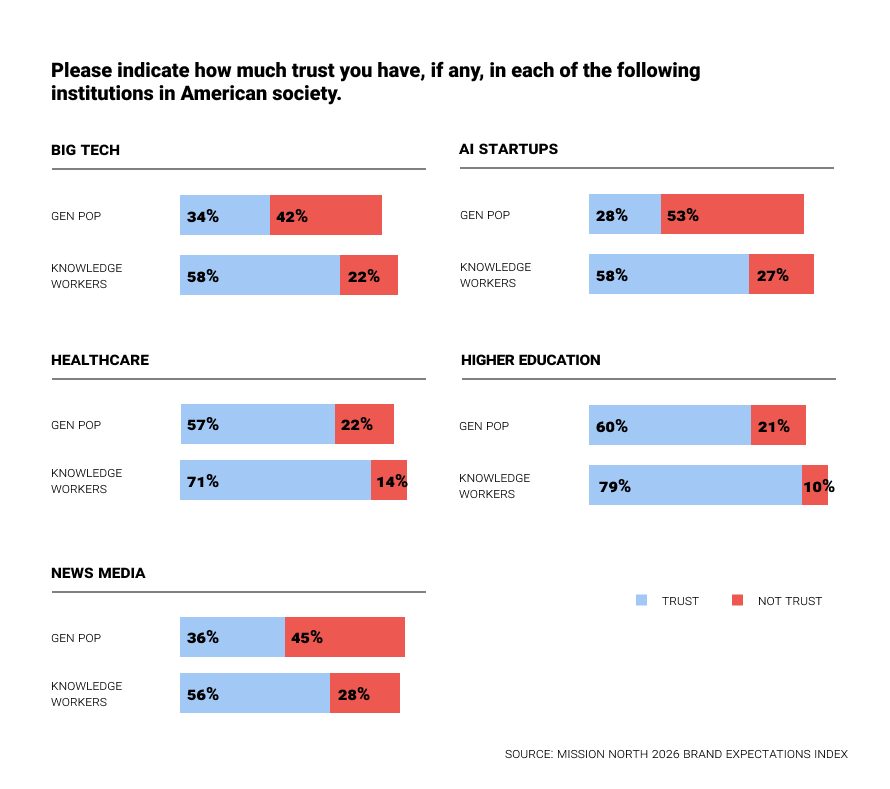
That is a meaningful opening for companies operating in complex, regulated, or high-scrutiny sectors.
But that trust is not passive.
Knowledge workers are more likely to recognize that corporate decisions involve trade-offs: legal constraints, regulatory pressures, market dynamics, operational risks, competing priorities, and incomplete information. That makes them more willing to trust institutions, but it also raises their expectations. They want companies to explain their judgment.
For communicators, the opportunity is not to simplify every decision into a cleaner story. It is to make the complexity understandable enough that audiences have a clear view into how the decision was made.
Our research shows that knowledge workers place greater weight than the general population on factors that indicate how decisions are made.
Sixty-three percent of knowledge workers value companies consulting outside experts, compared to 50% of the general population. Sixty percent value companies making their policy and legislative priorities clear, compared to 44% of the general population. And 66% place weight on the reputation of senior leadership, compared to 49% of the general population.
Those are not just brand perception metrics. They are evidence of how audiences evaluate judgment.
Those questions should shape the story before a position is announced. The strongest narratives do not simply explain where a company stands. They make clear what informs the position, why the company has a role in the conversation, and how the decision connects to the company’s responsibilities.
The strongest narratives do not simply explain where a company stands. They make clear what informs the position, why the company has a role in the conversation, and how the decision connects to the company's responsibilities.
When 60% of knowledge workers say a company's policy and legislative priorities influence how much they trust it, it changes how companies should think about when and why they speak.
Policy positions are no longer background material for government affairs teams. They are part of how informed audiences judge whether a company understands the environment in which it operates, the consequences of its choices, and the role it should play in public debate.
That does not mean every company needs to comment on every issue. In fact, the opposite is true. Credibility often comes from the discipline to know where a company has standing, where it has responsibility, and where it can add something useful. We encourage companies to ask whether the issue connects directly to their mission, values, expertise, customers, employees, or the responsibilities that come with their business. If that connection isn't clear, restraint is often the more credible choice.
The risk is not staying quiet on every issue.
The risk is showing up with a position that feels reactive, vague, self-interested, or disconnected from the people affected by it.
A strong policy position does more than state where a company stands. It explains why the company is engaging on the issue, who the decision affects, and how that position connects to what the company actually does.
Without that connective tissue, a position is easy to dismiss.
Our research shows that listening and responding to concerns influences trust for 75% of knowledge workers, compared to 61% of the general population. That finding matters because listening is not just what companies do after a decision is made. It is part of what makes the decision credible in the first place.
People do not expect perfect decisions. They do expect evidence that a company understands who is affected, what concerns are legitimate, and where the plan may need to change. This is especially true when companies face local resistance, regulatory pressure, employee concern, customer backlash, or public scrutiny. In those moments, listening cannot be a performative step in the communications plan. It has to shape the decision itself.
People do not expect perfect decisions. They do expect evidence that a company understands who is affected, what concerns are legitimate, and where the plan may need to change.
The companies that lose trust often do not lose it because they made a complicated decision. They lose it because the decision appears to have been made in a vacuum.
The organizations earning credibility make their process visible. They help stakeholders understand:
These are more than communications considerations. They are credibility signals.
In a low-trust environment, reputation will not belong to the companies with the loudest positions. It will belong to the companies whose decisions people can understand, scrutinize, and still believe were made with good judgment.

October 15, 2026
October 15, 2026

October 7, 2026
October 2, 2026