.svg)



October 27, 2026
October 27, 2026


Reading time
June 5, 2026
October 30, 2025
At Mission North, storytelling sits at the heart of how we help clients connect ideas to impact.
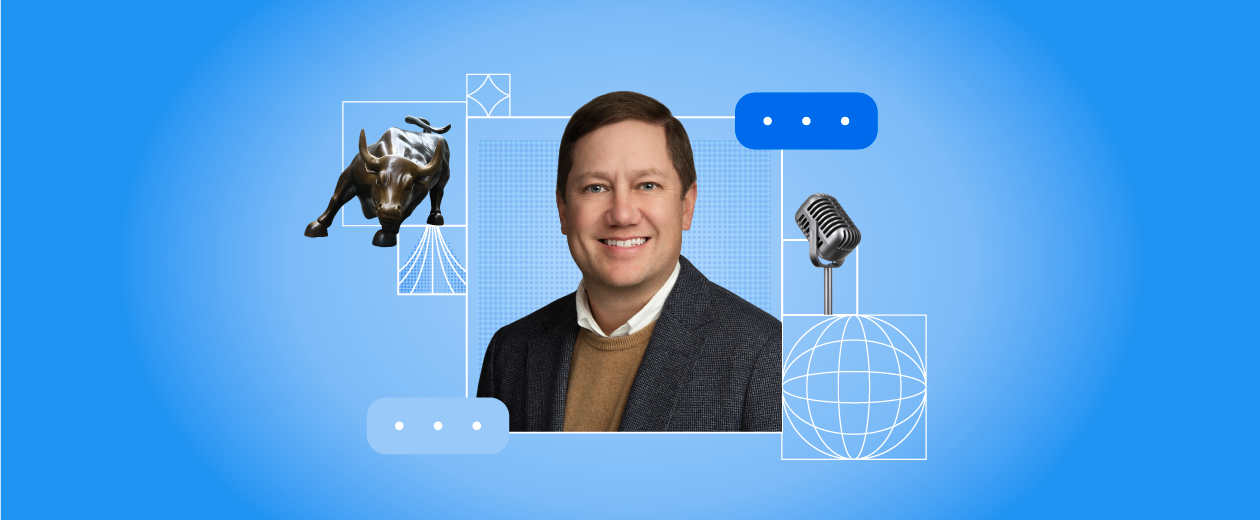
Few know that better than Rafe Needleman, Senior Vice President of Content and Media Strategy. He’s been shaping technology stories for decades, from editing CNET’s first product reviews to running Yahoo! Tech to ghostwriting for Fortune 500 executives.
We recently found a few minutes to talk about what makes a story worth telling, why even CEOs are just people, and how to keep AI from eating your voice.
To keep it simple, I say I’m a speechwriter. Everyone understands that, more than “thought leadership.” And it’s not that far off. Writing a speech isn’t that dissimilar from ghostwriting think pieces and social media content, which is what I spend 90% of my time doing.
The writing itself is the easy part. The real job becomes finding their message, and putting it into a form that they’ll approve, and that the comms team wants, and that hits all the right marketing messages. It takes a bit of diplomacy.
Curiosity. Caring about other people. Empathy.
One of the best jobs I ever had was at Red Herring, writing a daily column about startups. Every single day I wrote a column, most based on CEO or founder interviews. Even the most technical startups — the ones most humans wouldn’t understand — had fascinating stories.
When you get into what somebody cares about, what gets them up in the morning, everybody’s core interest is fascinating if you dig deep enough.
It turns out that everybody has a story in them. When you get into what somebody cares about, what gets them up in the morning, everybody’s core interest is fascinating if you dig deep enough. In the Red Herring work, finding that core was the whole game. And in the work I do now with executives — helping them with editorial platforms and thought leadership – it’s the same thing. Finding what they’re really into, making it human, and then attaching that to the business needs and technicalities of the content project.
Everybody likes talking about what they’re interested in and where they’re going. So being interested in that path is important to earning trust. Everybody is the hero of their own journey. A lot of people need guidance to tell that story, because we’re not in a society where we’re encouraged to go off on those flights. I try to give people the permission to do it. Then I just kind of sit back and listen.
For almost any content format, the most important thing is to grab the reader with an emotional hook: to entertain them, to make them feel something. If you do that before you give them the intellectual payload, the pill goes down easier.
That sometimes requires going beyond what the corporate message is supposed to be. Yes, you need to say X, Y and Z. But first you have to hook the reader as a person. That’s the human connection.
In all my years covering technology, AI is by far the most important advancement I’ve seen, not just to the world, but to me as a writer. It’s the first technology that has fundamentally changed what I do and how I do it and challenged my perception of who I am as a practitioner. I’ve been exploring what AI means for writers and editors since the day ChatGPT launched.
It depends on the project. There are times when I push AI aside, when I want to drive stick, shift gears manually. But there are other projects where AI is very helpful.
For learning a new technology I haven’t been exposed to, for example, I’ll scan the web, read stuff, orient myself using Google. But then I start to chat with AI, asking it to explain things given my particular background. It helps me shortcut the research phase that begins any editorial work.
I got my start in journalism not as a reporter or writer but as an editor. That core skill, editing, has really served me in working with AI. When it writes something, I edit it, then I tell it why I edited it. “You’re too casual,” or, “Your sentences are way too long,” or “Enough with the em dashes,” which, by the way, it doesn’t listen to.
As a writing assistant, AI is a drunk intern. It’s not always very good, but it is a second set of hands. Sometimes I use it to write a paragraph on something I might be unclear on, and it gives me a draft. Then I tell it how to rewrite it. I might go back and forth a dozen times or more, and then I rewrite it myself anyway.
Not a whole lot. But it does let me go through a lot more turns of the crank. It’s a good process to help me find the statue in the marble.
Right. We can’t get too precious about it. The most important thing to realize is that the audience, no matter how high-end or C-suite they are, are actual human beings. With one exception, which we can get to.
The most important thing to realize is that the audience, no matter how high-end or C-suite they are, are actual human beings.
Even CEOs pick up the kids, have hobbies, watch TV. Reaching people means taking a complicated message and putting it across in a way that human beings can understand and meet them where they are. Even CEOs watch TikTok. So how does the message translate to more modern media formats? Almost all messages will or can, but you have to think about who can produce that.
So in addition to the blog post, which is usually the mothership piece of content, you have to think about the social media post. And how is this story going to play on stage, in a podcast and more importantly these days, in that vertical video?
Yes, a big part of our audience is AI. What’s now called GEO, or AIO. It’s really important that the content we’re putting out is authoritative, differentiated, and unique, for the AIs to rank it as valuable. It’s a different game from SEO — that’s a whole other discussion. But here’s the paradox: writing in a more human way is actually better for AI pickup. Which means humans are still needed, thank goodness.
But here’s the paradox: writing in a more human way is actually better for AI pickup. Which means humans are still needed, thank goodness.
I’ve worked with a couple of different agencies now, and they’re all different. Mission North is small, which I like. We have really interesting clients. And we have an overweighting of editorial talent for the size of the agency, which means we take content very seriously.
Other agencies I’ve worked with, content is an afterthought sometimes, or not as integrated. Some other agencies are only content, which is also interesting. But being a full-service agency that puts such an emphasis on storytelling and high-quality content — it’s just an interesting mix.
Energy is super interesting. It is the only industry that really matters when you get down to it. What we eat comes from energy. How we move around is energy. AI is 100% an energy story. And energy is changing: how we generate it, nuclear, solar, all of that. How we transmit it. How we pay for it. I’m fascinated by energy.
I nerd out on home automation. My house is a Frankenstein’s monster of connected gadgets. I have a little computer running at the center of it. I’ve been working on home control literally since I was 14, playing with switches and long wires. Now it’s all computerized, and it’s stupid fun.
Even the most technical story is human if you go deep enough. Start with that — where the heart goes, the mind follows. Our job is to find that story and figure out how to tell it in every format that matters.
October 15, 2026
October 15, 2026