.svg)



October 22, 2026
October 22, 2026

Reading time
July 15, 2026
June 11, 2026
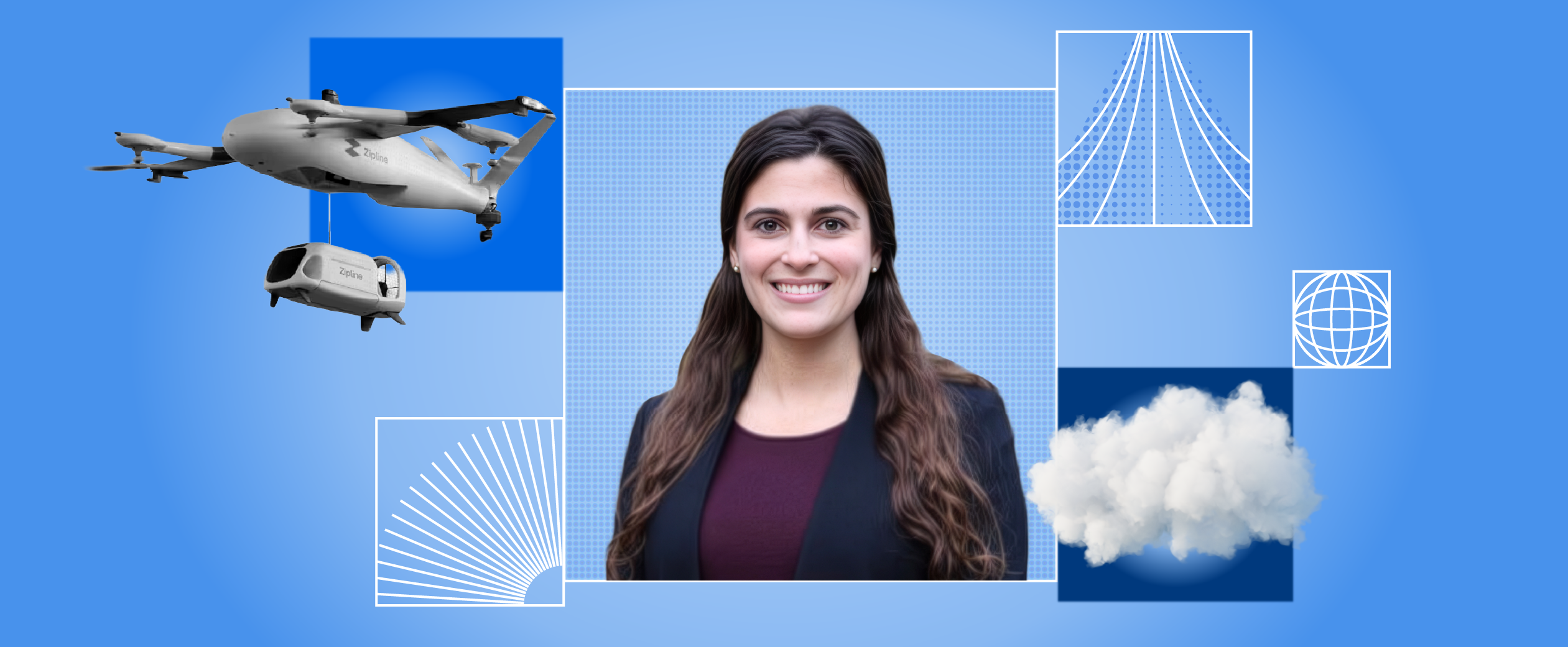
Danielle Meister Lurie has spent her career at the intersection of innovation and storytelling—from Tesla and WhatsApp to her current role as Head of Global Communications, Social + Film at Zipline, the company redefining what instant delivery looks like via the sky. She built Zipline's communications, social, and film function from scratch, and she's done it with a clear conviction: in a world of fractured attention and AI-generated everything, the communicators who can tell a truly human story across every channel will be the ones who matter most and break through the noise.
Our conversation has been edited for this format.
Storytelling is the oldest form of communication. Go visit the caves where people lived centuries ago, and you can see it etched on the walls. In some ways, modern storytelling has come full circle. It's still a mix of the written word and visuals that bring those words to life.
What's changed is the environment. Attention is completely fragmented. People aren't getting information from one place anymore, so you have to tell your story in as many places and in as many formats as possible. I used to think AI was going to put comms people out of business. Now I think comms people are going to be more important than ever.
I used to think AI was going to put comms people out of business. Now I think comms people are going to be more important than ever.
The volume of AI-generated content is only going up, and the number of people using these tools is still small compared to the total population. As that number increases, so too will all the noise, content and misinformation. Breaking through, standing out, communicating nuance, correcting misinformation… these are the things comms people have been doing forever. Human skills are becoming more valuable, not less.
Seeing is believing. That's been my hypothesis through every job I've had, from Tesla to WhatsApp to Zipline. With drone delivery, people have all these completely inaccurate preconceived notions about what that looks like. Film is how you change that.
Video is B-roll. Film lets you tell a story, show what's possible, and bring the magic to life. It creates emotion, connection and community. We launched this function in October 2024, right as we were about to roll out our next-generation home delivery service, and it was and remains central to everything.
Once people started seeing the value, doubling down became obvious. And the Go Direct movement was gaining momentum at the same time, which helped. But honestly, anyone who works in a sector like ours—where what we do is inherently visual—understands quickly that if you can't bring someone to a test site or a manufacturing facility, film and video are the next best thing.
Anyone who works in a sector like ours—where what we do is inherently visual—understands quickly that if you can't bring someone to a test site or a manufacturing facility, film and video are the next best thing.
The most important thing for executive communication today is authenticity, paired with transparency, integrity, and being genuinely human. Act, think, and talk like a person with real emotion. That's the gold standard, and will become increasingly more important in the age of AI.
For founders specifically, you have to layer in strategy as well, and get a great comms advisor to the table. Comms is part art, part science, part strategy, and part creative problem solving. I think of it like a chess game. If I do this, what will happen? This level of calculus is critical.
The whole point of authenticity is that you shouldn't have to try hard. Just be you. Put yourself in the mindset of the person absorbing your message, and speak to them like you would to a friend or a grandma if you’re talking about something complex. The person delivering the narrative needs to be an active participant in the process and have the final say. If it sounds like 15 lawyers wrote it, it's not going to work.
Ramp and Andriul have done really well with this. Astronomer, too. I'd never heard of Astronomer before, and then suddenly everyone had heard about them. They had their finger on the pulse of how people were consuming information in a particular moment, and they met people where they were. They leaned in and used it to their advantage. Now we all know who Astronomer is!
I'd also say Zipline has done a good job, which is probably why you asked me here.
It totally tracks and has informed a lot of our strategy the last few years at Zipline. But I think "getting it right" depends entirely on who you're talking to. The way you build trust in Washington, D.C. is very different from how you build it in San Francisco or Wichita or Accra or Lagos or Kigali.
For that reason, the most important thing any comms team can do right now is embrace a multifaceted strategy. Don’t turn off any channel just yet. The world-class comms of two years ago looks different than world-class comms today—and two years from now it'll look different again. We're at an inflection point. You have to test, iterate, learn, and calibrate based on the audience and the desired outcome.
We're at an inflection point. You have to test, iterate, learn, and calibrate based on the audience and the desired outcome.
Andrej Karpathy said it really well: coding used to be the language of intelligence, now that language is just English. My advice to communicators is simple: just try it. It's so much more than writing.
I spent a weekend building a financial tool with Claude. I was able to build something in a few hours that would have taken six to twelve months the traditional way. You can automate tasks, spin up agents, and build prediction systems. The ceiling is genuinely high. Plus, if you have a good idea but no technical background, that's no longer a barrier. The only thing you need now is curiosity, time and the willingness to roll up your sleeves.
I also like to pressure-test ideas by running a competition between the tools: comparing Claude with ChatGPT to see where they agree, where they diverge, and where the weaknesses are. It's really useful.
The multifaceted communicator!
You can't just be good at one thing now. You have to be a strong storyteller and strategist, plus fluent in social, video, events and more. You also must be capable with executive comms as well as government relations and financial audiences. Understand every stakeholder and be able to reach them. That's where comms is headed, and honestly, I think it's more interesting this way.
Danielle Meister Lurie is the Head of Global Comms, Social Media & Film at Zipline. This interview is part of Signalmakers, a Mission North series exploring how modern communicators blend curiosity, critical thinking, and creativity to lead in an AI-driven world.

October 15, 2026
October 15, 2026
October 7, 2026
October 2, 2026